


Default chili: What AI writing still needs from humans
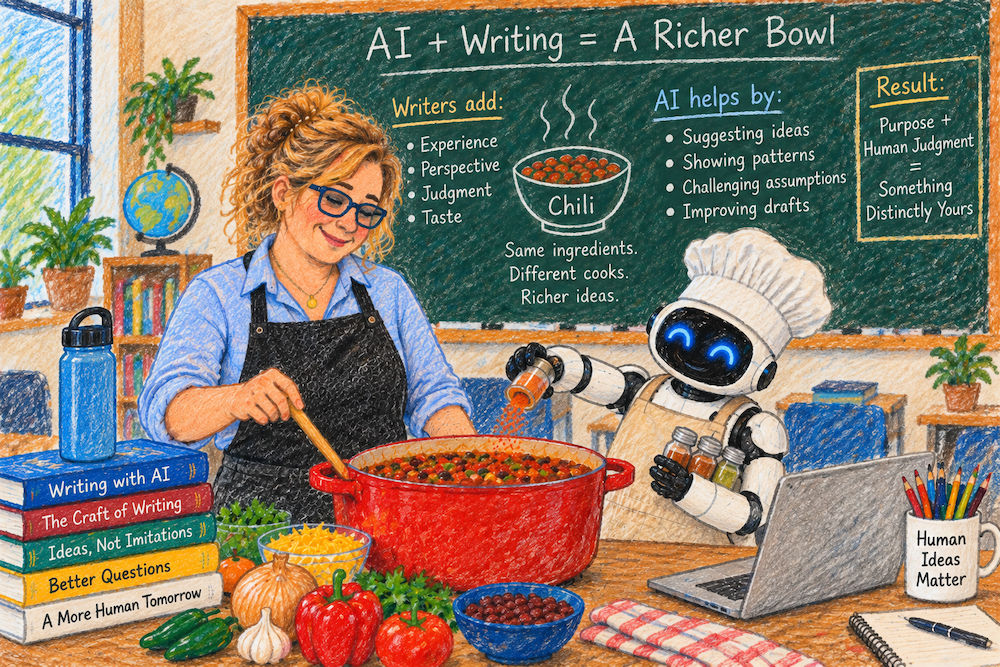
I have been thinking about AI and writing, and for reasons that made perfect sense in my head, I started thinking about chili (I do live in Texas, if that provides any insight).
Every writer makes a different pot. We may begin with many of the same ingredients, but what emerges reflects where we learned to cook, whom we expect to feed, what we have tasted before, and what we believe belongs in the bowl.
Some writers add heat. Others add sweetness. Some follow a recipe handed down through generations, while others are willing to offend half the state of Texas by putting beans in the pot.
The ingredients matter, of course, but the cook is what makes the chili distinctive.
That led me to a question. If a large language model has been trained on an enormous body of human writing, is using it like dumping millions of good chilis into one enormous pot? Does everything go in, only for an “everything chili” to come out that is technically impressive but not especially satisfying to any particular palate?
It was an original metaphor and, I thought, a pretty good one. So I did something that captures both the promise and the proper use of AI. I asked the model to challenge it.
The response was useful because it did not simply agree with me. The metaphor captured a real risk, but it described the technology incorrectly. A language model does not ordinarily retrieve millions of finished pieces of writing, pour them together, and serve the average.
A more faithful comparison is that it has observed an extraordinary number of cooking demonstrations. It has learned which ingredients commonly appear together, which combinations people recognize, and what usually comes next in a familiar recipe.
When asked to make chili, it constructs a new bowl from those patterns.That correction produced a better phrase than the one I started with.
The central danger is not “everything chili”. It is “default chili.”
A shallow conversation about AI writing
Default chili is recognizable, balanced, and broadly acceptable. Few people will refuse to eat it. It may even be quite good.
Yet there is little in it that reveals who cooked it, why it was made, or why this particular bowl needed to exist. It tastes like a capable version of what chili usually tastes like.
Anyone who works with AI has seen the written equivalent. The sentences are clean, the tone is polished, and the structure is orderly. Every paragraph appears to belong, yet the finished piece could have come from almost anyone and could be addressed to almost anyone.
A message intended for one school community could be sent to another by changing the name. A leadership reflection sounds thoughtful but reveals no actual thought the leader was willing to claim. A report contains all the expected language and still leaves the reader wondering what the author believes.
More ingredients do not necessarily solve the problem. A user can dump pages of notes, reports, research, quotations, and instructions into the pot. AI will work diligently with all of it.
Without a clear human point of view, however, the model will tend to produce what writing of that kind usually sounds like. Information can make the bowl fuller without making the flavor more distinctive.
This is where I think our conversation about AI writing often becomes too shallow. We debate whether people should use AI, when the more important question is what they are contributing when they do.
A blank page is not morally superior to a language model. Human beings have always learned by reading other writers, borrowing forms, adapting ideas, and working with editors. I must’ve read close to 1,000 books before
I published my first. My point being every author has tasted someone else’s chili. Influence is not the problem.
The author’s responsibility is to bring taste and judgment. The author knows the audience, understands the stakes, feels the tension, and decides what deserves to be said.
The model can recognize patterns associated with empathy, courage, urgency, or conviction. The human being has to determine whether any of those qualities are actually warranted in this moment. The model can suggest an ingredient.
The author has to taste the pot.
Flawless without fingerprints
I can almost immediately detect when someone has invested zero time in something AI produced. Most experienced leaders can.
The message may be grammatically flawless, but it has no fingerprints. It contains the appearance of care without evidence that anyone cared enough to make a choice. Do not be that person.
Do not fall into the trap of believing that a finished looking product represents finished thinking.
This article is itself a small case study. I brought the chili metaphor and the concern underneath it. AI helped me test the comparison, exposed where my original claim was inaccurate, and offered language that sharpened the idea. I decided which observations mattered, which ones sounded too easy, and where the argument needed to go next.
The process was chef-inspired with assistance. The technology improved the cooking, but it did not supply the reason for the meal.
For superintendents, that distinction reaches beyond our personal writing. We are also deciding how AI will enter our systems.
If we introduce it primarily to save time and produce more, we should not be surprised when our organizations produce larger quantities of default chili. Staff members will learn that the goal is completion.
Generic family messages, campus plans, employee recognitions, board updates, and instructional materials may become easier to generate while becoming less connected to the people they are supposed to serve.
The organizational question, then, is not satisfied by an acceptable use policy or a collection of prompt templates. Those may be necessary, but they will not cultivate taste.
Efficient answers to inherited questions?
Our systems communicate what thoughtful work looks like. Do we value speed more than discernment?
Do people feel expected to challenge the first response a model gives them? Can the employee closest to the problem recognize lived reality in the final product? Would the recipient feel written to, or merely processed?
These questions should matter deeply to you because default writing can quietly become default thinking. Language shapes what an organization notices, what it avoids, and what it is willing to name.
If AI continually supplies the first framing and humans merely approve it, the model begins to influence more than our sentences. It begins to influence the boundaries of the questions we ask.
An efficient answer to an inherited question may keep us from recognizing that we needed a different question altogether. I sincerely hope this paragraph causes you a moment of pause.
There is also a leadership cost when our words become interchangeable. A superintendent’s writing is rarely only about transmitting information. We write to make sense of complexity, to show people how we are thinking, to acknowledge what is difficult, and to establish what deserves attention.
Readers do not need every communication to be profound. They do need some evidence that a person with knowledge of their circumstances stood behind the words.
That evidence often comes from the ingredient that makes the writing less universally agreeable. It may be an unusual metaphor (something I tend to overuse, quite honestly), a personal experience, an uncomfortable truth, or a judgment stated plainly enough that someone could disagree.
AI tends to smooth those edges unless we deliberately preserve them. The rough edge may be the very thing that tells the reader a human being was present.
Why chili needs to exist
Perhaps originality in the age of AI should not be measured by whether a person typed every word alone. A more useful measure is whether the person brought an idea worth developing, exercised judgment throughout the process, and accepted responsibility for the result.
AI can help us interrogate a metaphor, organize an argument, notice what is missing, and improve a sentence. It can be a remarkably capable kitchen assistant. It should never relieve the author of becoming a cook.
So use AI. Invite it into the kitchen. Ask it to challenge the recipe, suggest a substitution, or tell you when one flavor has overwhelmed the pot.
Then taste what it produces. Add what only you would know to add. Remove what sounds polished but means nothing.
Make certain the final bowl reflects the people who will receive it and the reason you began cooking in the first place.
If we bring AI only ingredients, we should expect default chili. When we bring it purpose, experience, judgment, and a taste we are willing to defend, it can help us make something distinctly ours.
The model may know how chili is usually made. The author must know why this chili needs to exist.
The image above was created with AI.