

AI & the automobile: How we make revolutionary tech safe
In the early years of the automobile, America embraced the machine long before it understood the responsibility that would eventually surround it. Cars represented freedom, mobility, independence, and progress.
Entire communities reorganized themselves around the promise of rapid transportation. Roads expanded, suburbs emerged, commerce accelerated, and the automobile quickly transformed from curiosity to necessity.
The technology moved faster than society’s ability to fully understand its consequences. What is difficult for modern readers to appreciate is just how dangerous the early automobile era truly was.
Children rode freely in the back seats of cars without restraints. Parents drove after drinking with little public stigma and minimal legal consequences. Speed limits were inconsistent or nonexistent in many places. Driver education was primitive.
Crash testing had not yet evolved into a scientific discipline. Seat belts were rare, airbags were decades away, and even basic understandings of traumatic injury remained underdeveloped.
Yet the overwhelming majority of people living during that time did not view themselves as irresponsible. They were simply participating in a civilization still learning how to coexist with a powerful new technology.
Over time, however, society began constructing layers of protection around the automobile. The machine itself did not disappear, nor did society reject the benefits it provided.
Instead, communities slowly recognized that technological advancement required parallel advancement in public policy, engineering, ethics, and cultural norms.
Speed limits emerged. Licensing requirements became standardized. Laws governing intoxicated driving were strengthened.
Seat belts became mandatory in vehicles and eventually mandatory for passengers. Airbags became standard. Child safety seats evolved. Crash testing matured.
Graduated licensing systems recognized that novice drivers required different rules and safeguards than experienced adults.
What makes this progression so important is that none of these protections existed at the beginning. The invention preceded the wisdom necessary to safely govern the invention.
Please read that sentence again. Artificial intelligence may now be placing society in a remarkably similar moment.
How we think about AI
Like the automobile before it, AI has arrived with extraordinary promise. It is already reshaping communication, creativity, medicine, research, business operations, and education itself.
Schools across the country are simultaneously attempting to understand how these tools might support instruction while also wrestling with profound concerns regarding authorship, misinformation, bias, intellectual dependency, and the future role of human cognition.
The pace of advancement has been staggering, often outstripping the ability of institutions to establish clear norms, expectations, and safeguards. As a result, much of the public conversation surrounding AI tends to oscillate between two extremes.
Some view the technology almost exclusively through the lens of fear, predicting catastrophic consequences for learning, employment, and even democracy itself. Others embrace AI with near evangelical optimism, assuming that innovation alone will naturally solve the problems innovation creates.
History suggests that both reactions may be incomplete.
The automobile offers a more useful framework because it reminds us that transformative technologies often mature socially long after they mature mechanically. The earliest cars were not accompanied by sophisticated regulatory systems, advanced safety standards, or deeply developed cultural expectations regarding responsible use.
Those systems emerged gradually through experience, failure, tragedy, research, and collective learning. Society did not make automobiles safer by eliminating them. Society made automobiles safer by building increasingly sophisticated systems around them.
Perhaps the most important people in that historical story were not the inventors of the automobile itself, but the children riding quietly in the back seat.
Those children grew up. They became engineers who redesigned vehicle safety systems. They became physicians who studied trauma and survivability. They became lawmakers who strengthened regulations surrounding impaired driving and passenger safety.
They became researchers who analyzed crash data, educators who taught safer driving practices, and parents who demanded better protections for future generations. The generation raised inside the danger eventually became the generation responsible for reducing it.
That possibility should profoundly shape how educational leaders think about artificial intelligence.
Wielding power responsibly
The central question facing schools may not simply be whether students should use AI tools in classrooms. Important as that conversation may be, it remains fundamentally operational in nature.
The larger and far more consequential question is whether schools are preparing students to someday govern technologies that adults themselves do not yet fully understand.
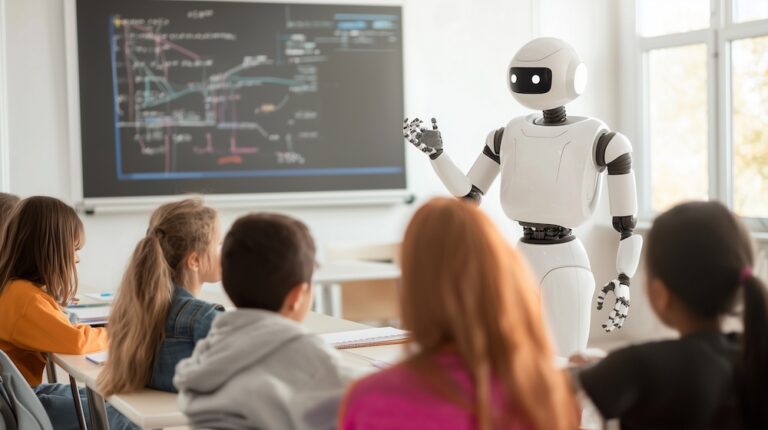
Today’s students are growing up immersed in algorithmic systems, synthetic media, generative platforms, and machine-assisted decision-making before society has fully established the guardrails surrounding those systems. They are witnessing debates about truth, authorship, labor, surveillance, ethics, and intellectual ownership unfold in real time.
In many ways, they are the children sitting in the back seat of AI.
This reality may require educational leaders to rethink what future readiness actually means. For years, conversations about technology in schools focused primarily on access and implementation.
Could districts provide devices? Could classrooms integrate digital tools effectively? Could students become technologically fluent enough to compete in an increasingly digital economy?
Those questions still matter, but AI introduces another layer entirely. Technological fluency alone will not be sufficient in a world increasingly shaped by intelligent machines.
Students will require ethical reasoning, discernment, systems thinking, intellectual humility, and the ability to navigate environments saturated with synthetic information. They will need to understand not only how to use technology, but how to question it, challenge it, regulate it, and humanize it.
Most importantly, they will need educational experiences that strengthen the distinctly human capacities machines cannot easily replicate: wisdom, empathy, moral judgment, creativity rooted in lived experience, and the ability to responsibly wield power on behalf of others.
The future we are creating
History suggests that powerful technologies are rarely made safe by the technology itself. They become safer when societies develop the moral maturity necessary to govern them wisely.
The automobile did not become safer because engines became less powerful. Modern vehicles are faster and more technologically advanced than ever before.
They became safer because generations of people slowly constructed legal frameworks, engineering standards, public expectations, accountability systems, and cultural norms capable of reducing harm while preserving benefit.
Artificial intelligence will likely require a similar evolution. And if that is true, then the work of schools becomes even more significant.
Somewhere in our classrooms right now sits the future engineer who will design safer AI systems. Somewhere sits the future legislator who will shape regulatory policy.
Somewhere sits the future ethicist who will challenge dangerous applications, the future educator who will redefine human learning in an age of intelligent machines, and the future parent who will insist upon safeguards we cannot yet imagine.
We often speak about preparing students for the future. Increasingly, however, the deeper responsibility may be preparing students to protect humanity from the unintended consequences of the future we have already begun creating for them.
[soliloquy id=”138239″]